PM Modi’s Iran-Israel War Warning: Why He Compared the Conflict to COVID-19? | Khabar For You
- DIVYA MOHAN MEHRA
- 24 Mar, 2026
- 98650

Email:-DMM@khabarforyou.com
Instagram:-@thedivyamehra


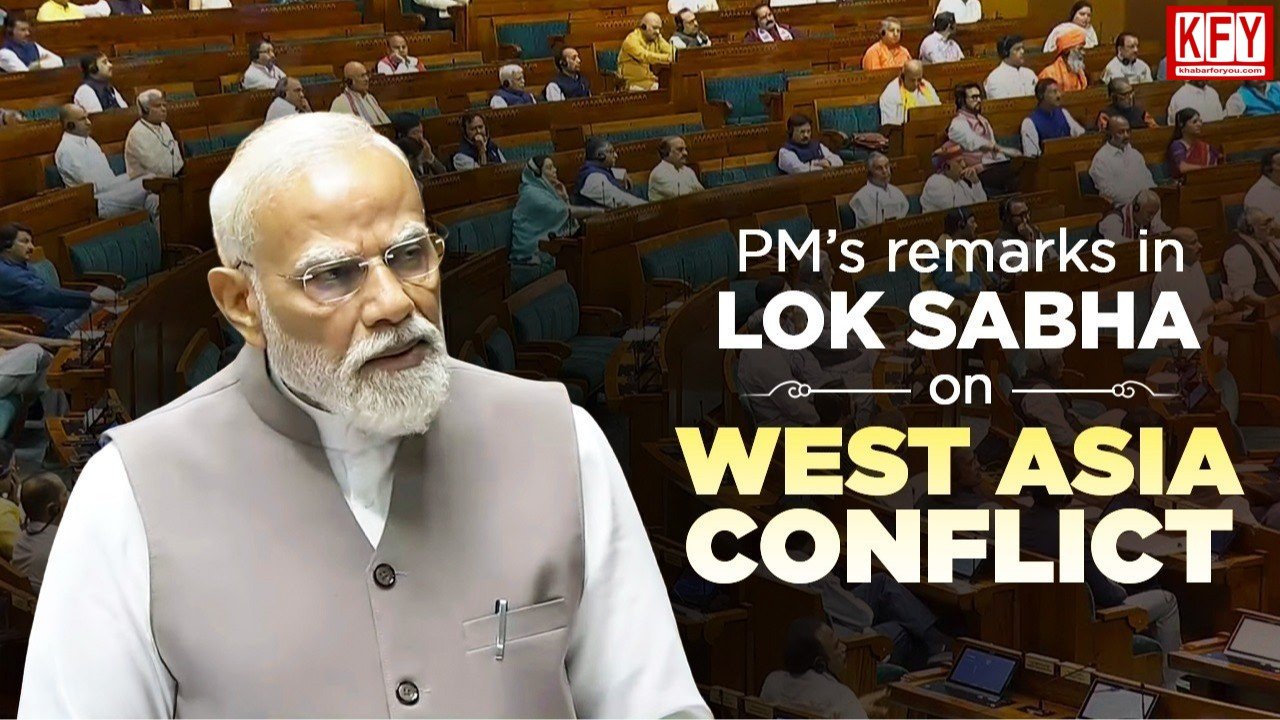
In a somber 25-minute address to the Lok Sabha on Monday, Prime Minister Narendra Modi drew a startling parallel that has sent shockwaves through India’s diplomatic and economic corridors. Speaking on the 24th day of a devastating conflict between Israel, the United States, and Iran, the Prime Minister likened the current geopolitical crisis to the COVID-19 pandemic, calling for national unity and "war-footing" preparedness to mitigate a looming domestic shock.
Read More - IPL 2026 Schedule & Investigative Report: Phase 1 Venues, Rivalries & Strategy | KhabarForYou
"The world is passing through a period of deep instability," Modi told a hushed Parliament. "Just as we stood together during the COVID-19 pandemic to face an invisible enemy, we must now unite to face the tangible, unprecedented challenges posed by this war."
The comparison is not merely rhetorical. An investigation into the government’s recent Cabinet Committee on Security (CCS) briefings reveals a nation bracing for a supply-chain contagion that could rival the 2020 lockdowns in economic severity.
The ‘Hormuz Heart Attack’: Why India is Worried
At the heart of the Prime Minister’s alarm is the Strait of Hormuz - the world’s most sensitive energy artery. Since the conflict escalated on February 28 following "Operation Epic Fury," Iran has effectively blockaded the waterway.
For India, this is an existential threat. Sources in the Ministry of Petroleum and Natural Gas confirm that despite diversifying energy imports from 27 to 41 countries over the last decade, nearly 60% of India’s Liquified Petroleum Gas (LPG) and a significant portion of its crude oil still transit through this chokepoint.
"Energy is the backbone of the economy," Modi noted, acknowledging that the "Strait has become highly challenging." To counter this, the government has begun prioritizing domestic LPG for households, a move reminiscent of the essential services prioritization seen during the 2020 lockdowns.
The Human Cost: 10 Million Lives in the Crosshairs
While the economic stakes are high, the humanitarian stakes are higher. Over one crore (10 million) Indians live and work in the Gulf region. The Prime Minister confirmed that at least six Indians have already lost their lives in the crossfire, with several others injured.
In a massive logistical undertaking dubbed by some as "Vande Bharat 2.0," the government has already facilitated the return of over 375,000 Indians. This includes approximately 1,000 evacuees from Iran itself, many of whom are medical students whose education has been abruptly severed.
The CBSE has already cancelled examinations in Gulf-based Indian schools, a move that mirrors the educational disruptions of the pandemic years. "The security of Indians is our greatest priority," Modi emphasized, noting he has held two rounds of direct talks with West Asian heads of state to ensure the safety of the diaspora.
The Fertalizer & Food Security Shield
Investigative data suggests the government’s deepest fear is a spike in food inflation. During the pandemic, global urea prices soared to ₹3,000 per bag, yet the Indian government maintained a subsidized rate of under ₹300.
In his speech, Modi reassured the agrarian heartland that despite the Middle East being a primary source of fertilizers, India has built a "strategic buffer."
Strategic Petroleum Reserve: Currently stands at 5.3 million metric tons.
Coal Output: Topped 1 billion tons annually to ensure the power grid remains immune to gas shortages.
Renewable Shift: Solar capacity has reached 140 GW, providing a partial cushion against fossil fuel volatility.
The Political Friction
Despite the call for unity, the Prime Minister’s "pandemic parallel" has met with sharp critiques from the Opposition. Leaders from the Congress and other parties have moved notices in Parliament, questioning the government's perceived "silence" in the early days of the conflict and the lack of a formal condolence following the death of Iranian Supreme Leader Ali Khamenei.
"The Prime Minister asks for the same unity we showed in COVID, but we remember the oxygen shortages and the lack of data," remarked an Opposition MP on the condition of anonymity. "You cannot use a tragedy to mask a lack of diplomatic foresight."
Vigilance Against ‘Internal Contagion’
Perhaps the most telling part of the Prime Minister's address was his warning against "opportunistic elements." Modi alerted state governments to be "vigilant and cautious" against hoarding, black-marketing, and the spread of misinformation.
"When global systems break, internal cracks appear," a senior home ministry official told our reporters. "The PM is worried that if fuel prices or essential goods become scarce, it could lead to civil unrest. The 'COVID-style' response isn't just about logistics; it’s about internal security and keeping the social fabric intact."
The Road Ahead: Diplomacy or Defiance?
India finds itself in a precarious diplomatic balancing act. While Modi condemned attacks on "critical infrastructure" and "international waterways" - a veiled criticism of Iranian tactics - he has conspicuously avoided joining any U.S.-led military coalitions to reopen the Strait of Hormuz.
Instead, New Delhi is leaning heavily on "Dialogue and Diplomacy," maintaining a direct line with Tehran’s President Masoud Pezeshkian while managing its strategic partnership with Washington and Israel.
As the war enters its fourth week with no end in sight, the Prime Minister’s message is clear: the "worrisome" situation is the new normal. For a nation still recovering from the scars of a global health crisis, the "Pandemic of War" represents the ultimate test of India’s resilience, self-reliance (Atmanirbharta), and global standing.
Business, Sports, Lifestyle ,Politics ,Entertainment ,Technology ,National ,World ,Travel ,Editorial and Article में सबसे बड़ी समाचार कहानियों के शीर्ष पर बने रहने के लिए, हमारे subscriber-to-our-newsletter khabarforyou.com पर बॉटम लाइन पर साइन अप करें। |
| यदि आपके या आपके किसी जानने वाले के पास प्रकाशित करने के लिए कोई समाचार है, तो इस हेल्पलाइन पर कॉल करें या व्हाट्सअप करें: 8502024040 |
#KFY #KFYNEWS #KHABARFORYOU #WORLDNEWS
नवीनतम PODCAST सुनें, केवल The FM Yours पर
Click for more trending Khabar
Leave a Reply
Your email address will not be published. Required fields are marked *
Search
Category